Showing posts with label Tumblr. Show all posts

Tuesday, March 8, 2022

The impacts of growing up with the family disease of alcoholism

The impacts of growing up with the family disease of alcoholism

The impacts of growing up with the family disease of alcoholism

Mon, 07 Mar 2022 16:04:47 +0000

This article originally appeared on:

al-anon.org/blog/the-impacts-of-growing-up-with-the-family-disease-of-alcoholism/

Perspectives from Al‑Anon Members & Professionals

The impacts of growing up with the family disease of alcoholism

You can find out more about the family disease of alcoholism and its effects on children by checking out the new “Perspectives: ‘Growing up with the family disease of alcoholism’” playlist on the Al‑Anon Family Group Headquarters, Inc. YouTube channel. It includes interviews with Al‑Anon and Alateen members and professionals that specialize in the field of addiction medicine.

.fusion-button.button-1.button-3d,.fusion-button.button-1.button-3d:hover{box-shadow:inset 0 1px 0 #fff, 0 0.15em 0 #2a51aa, 0.1em 0.2em 0.2em 0.15em rgba(0, 0, 0, 0.3);}.fusion-button.button-1.button-3d:active,.fusion-button.button-1.button-3d:hover:active{box-shadow:inset 0 1px 0 #fff, 0 1px 0 #2a51aa, 0.05em 0.1em 0.1em 0.07em rgba(0, 0, 0, 0.3);}.fusion-button.button-1{border-radius:50px 50px 50px 50px;}“Growing up with the family disease of alcoholism” playlist

Disclaimers:

This video includes interviews with Al‑Anon and Alateen members from Al‑Anon and Alateen’s Role in Family Recovery (AV‑31DVD) and various professionals.

The opinions expressed are strictly those of the person who gave them.

Al‑Anon/Alateen members’ identities are protected so they can share openly and honestly about their experience with a loved one’s drinking and with the Al‑Anon/Alateen program.

Al‑Anon cooperates with therapists, counselors, and other professionals, but does not endorse, oppose, or affiliate with any professional, organization, or entity. Their comments reflect their professional expertise and use of Al‑Anon as a resource for their clients and patients who are or have been affected by an individual’s addiction to alcohol.

Video Transcript

Perspectives from Al‑Anon Members & Professionals

The impacts of growing up with the family disease of alcoholism

JERRY MOE, CHILDREN AND FAMILY COUNSELOR: What we know is that one out of every four children in the United States today is growing up in a family and they love someone who suffers from the disease of alcoholism. And this disease, insidious disease, is characterized by denial, silence, secrecy, and shame. And so many of these boys and girls are silent and invisible.

AL‑ANON MEMBER: It got to a point where I grew up, you know, stuffing everything that was in my life, whether it was family secrets or my feelings. It was very uncomfortable to be who I was. I always ran away when I was young and came back at home at night. And as the alcoholism increased, it was, you know, sort of unbearable. To have anyone that knew me to come to my house because you didn’t know what was going to happen, whether it was going to be, you know, some kind of chaos or drama or any arguments and the fighting. It was just, you know, confusion at its peak. And it was scary growing up.

ALATEEN MEMBER: It was it was chaos all around. And, you know, I try to like because I’m the youngest and I’ve always tried to be like the center of the attention, trying to keep everyone happy. It’s really hard because my siblings don’t really have a good relationship with my father and I’m really close to him. I guess we didn’t really realize that at that a alcoholism would affect me that much because I’ve never really seen, I never seen my dad drink.

NANCY DUFF‑BOEHM, CLINICAL PSYCHOLOGIST: The eggshell syndrome where everybody in the household of an alcoholic needs to be walking very, very carefully, not to trigger a reaction and from the alcoholic. That generates a hyper arousal, a chronic hyper arousal in every other person in the household. This hyper arousal elevates the stress hormones in a person’s body so that that destroys as many organs as quickly as alcohol does.

And in addition to the anxiety, there’s the resentment, the anger that this addict or alcoholic is not taking responsibility for their part of the family business so that this becomes a powder keg. Something is going to happen that is going to skew that child’s or that individual’s life, and it can end up in a rage reaction.

So, it’s the eggshell syndrome that that leads to a hyper arousal, chronic hyper arousal. And then also the family secrets. It’s very typical, in an alcoholic family that everybody understands that none of this is to leave the four walls of the house. You know, the way they do this is, of course, keeping the information from the children. But of course, the children catch on anyway. And so when they say something, it’s, “Oh, no, no, no, that’s not the truth.” Which leads the child to doubt themselves, leading to low self‑esteem, or to really resenting the parent, which will lead to, you know, crazy adolescent rebellion reactions.

ANN MCGREEVY, SUPERVISOR OF PSYCHOLOGICAL STUDIES AT FREDERICK COUNTY PUBLIC SCHOOLS: When you’re a child or an adolescent, it really doesn’t matter what a family member is addicted to. It is impacting the family.

And if you have done any reading or studying on adverse childhood experiences, you know that a family member’s addiction is one of the adverse childhood experiences. And so, it’s impacting the child’s brain development. It’s impacting the child’s social ability to interact with other children their age. It’s impacting the child’s ability to form meaningful adult relationships. So, it’s impacting the child and adolescents functioning across the board.

So, alcohol addiction is just as detrimental as any other addiction on a child’s functioning. And as you’ve heard, and as you know, it can set patterns for life long, dysfunctional interactions and relationships.

ALATEEN MEMBER: Before coming to Alateen, my life was pretty much going downhill, you know, having fights every day with my mom and stuff like that and doing bad in school just to get attention because I wasn’t getting it from the alcoholic or the drug addict in my family. So, I would seek, you know, different stuff to try to get attention. And it wasn’t benefiting me in any kind of way.

AL‑ANON MEMBER: Before I had jobs where I would work there for months, three months, for a year even. And then, you know, I’d lose my temper and I’d lose my job. You know, now I have an education, I have a career, I have a relationship with the alcoholic.

Before Al‑Anon, I hated the alcoholic. Wanted nothing to do with him – just total resentment, just poisoned me. You know, today I have a relationship with the alcoholic. And it’s come through building boundaries. You know, I have very set boundaries with the alcoholic. And by maintaining those boundaries, I’m able to have a relationship with him. Something I thought was never possible. Because hating your dad doesn’t work.

You know, a lot of people go, “I hate my dad. I don’t want anything to do with him.” Doesn’t work. He’s my dad. You know, he raised me. He was my hero for a long, long time. And then the disease got him. You know, my heroes still there. He’s just got a disease.

So, you know, today I’m able to, you know, sit down, and talk with him, I’m able to go out and go fishing with him, and I’m able to have a relationship with this man that I hated for so long. Something I thought would never happen. And that’s cause I work the program.

CATHY BERRICK, BA/BSW: Well, recognizing alcoholism in the family is a difficult thing. Obviously, denial is the hallmark of addiction. So, it’s a difficult thing to see as a family member.

What I would always say and have always said to family members is it’s not how much someone’s drinking. It’s not how often they’re drinking. It’s what happens when they do. And if that person’s drinking is upsetting you, if it’s creating situations that are making you worry, become angry, fearful, ashamed, then chances are you have the family illness of alcoholism present.

AL‑ANON MEMBER: I found coming to Al‑Anon that there was some sort of common ground, a feeling of acceptance and learning that alcoholism was a disease and that I played no part in causing it. And I was very limited to even think that I, you know, could cure it. So, as I came to meetings, I learned that I cannot control it. So, if I wanted to be healthy and happy. It was up to me.

AL‑ANON MEMBER: I learned what it meant to be to have a place where you can go, where you know that you’re not alone, where you can share what’s in your heart, your mind, and your soul, and know that you’re not going to be criticized for it. Know that you’re not going to be judged for what you did. Know that it’s okay to love an alcoholic and it’s okay to start to learn how to love yourself, how to keep the focus on you. And how you’re worth it.

The post The impacts of growing up with the family disease of alcoholism appeared first on Al-Anon Family Groups.

All In Solutions Counseling Center is a substance abuse treatment network. We outpatient and inpatient substance abuse treatment programs that are tailored to meet each client’s needs. Our specialized programs include:

Our locations include:

Did you miss our previous article…
https://www.allinsolutions.com/how-to-tell-if-fentanyl-is-present-meet-beth-weinstock-of-birdielight/

The impacts of growing up with the family disease of alcoholism-All In Solutions-All In Solutions - A Solutions Based Behavioral Healthcare Group


from All In Solutions https://ift.tt/KjzQAMq
from Tumblr https://ift.tt/lMfX51w
via IFTTT

AATOD to sponsors of methadone reform bills: Keep OTPs involved in dispensing

AATOD to sponsors of methadone reform bills: Keep OTPs involved in dispensing

AATOD to sponsors of methadone reform bills: Keep OTPs involved in dispensing

Mon, 07 Mar 2022 20:05:01 +0000

This article originally appeared on:

atforum.com/2022/03/aatod-methadone-reform-bills-dispensing/

The American Association for the Treatment of Opioid Dependence (AATOD) on March 2 sent letters to the sponsors of proposals which would liberalize methadone regulations. While AATOD supports much of what is in the bills, it differs in particular on take-home prescribing of methadone through pharmacies. The two methadone reform bills, one in the Senate (S.3629, see https://ift.tt/W83TuZm) and one in the House of Representatives (H.R. 6279, see https://ift.tt/uCSdxvV Forum) contain identical language allowing pharmacies to dispense methadone.

Importantly, AATOD has changed its position on one issue: “stable” patients as defined by the Substance Abuse and Mental Health Services Administration (SAMHSA) should be able to receive their take-home medication through pharmacies, at the discretion of the opioid treatment program (OTP) director. “To be clear, this would involve methadone-maintained patients, who are currently enrolled in OTPs,” the letter, from AATOD president Mark Parrino, states. “We also recommend that the legislation include a requirement for an agreement between an OTP and a pharmacy to ensure electronic communication of prescriptions that cannot be duplicated or altered in any way and can require two-way communication such that the pharmacy is able to report to the OTP any problems with the dispensing of the medication.”

OTPs well know that their patients need their methadone. The average pharmacy may not understand that it’s not okay to say “we don’t have it in stock now, we need to order it, it will be here in a few days.”

AATOD continues to oppose the dispensing of methadone by pharmacies when the prescriptions come from physicians who are not affiliated with OTPs – something which is not currently allowed.

No self-induction, says AATOD

The bills suggests that prescribing should adhere to the 30-mg dose limit, but this does not mean induction should be done at home – and these bills would allow that. “Most methadone treatment related deaths occur in the first 3 to 10 days of treatment,” states the letter to the Senate and House sponsors, a copy of which was obtained by AT Forum. “OTPs can provide proper supervision during induction. Community prescribers and pharmacies cannot.”

In fact, there is no way to ensure that physician offices would adhere to any dose limits, AATOD notes.

This is not about protecting OTP turf. It’s about protecting the integrity of treating OUDs with methadone. If the trained providers are no longer guarding patient safety, it could mean that methadone quickly goes the way of many opioid pain medications. There are five federal reports linking methadone overdose deaths with primary care prescribing for pain.

The COVID-19 relaxations of take-home rules showed that many patients who are “unstable” are capable of managing take-home doses safely, but “the reality is that we do still serve a significant number of patients that would have a high likelihood of diverting their methadone.”

A monthly supply of methadone from community pharmacies could increase diversion, AATOD notes. And it’s not only AATOD. A January 10, 2022 letter from the American Academy of Addiction Psychiatry, also sent to the lawmakers, states that provisions of the methadone reform bills that “would allow certain providers to prescribe up to one month of take-home methadone doses to be dispensed from a community pharmacy may have unintended consequences.”

As for the five reports detailing the methadone overdoses from prescriptions for pain, AATOD states that “losing sight of the findings of these national reports is extremely dangerous.” Particularly now, when the opioid use epidemic is defined by illicit fentanyl, it could be harmful, not beneficial, “to have practitioners prescribe methadone to treat opioid use disorder outside of the scope of regulated OTPs, which use treatment teams and not individual practitioners, to treat patients.”

As for the other provisions of the bills, AATOD is completely supportive. These provisions include:

Exemptions for treatment regulations during COVID-19 emergencyThe definition of stable patients under the COVID-19 emergency rules for takehomescompleting a minimum of 60 days of treatment whose medical record documentsthe benefits of providing unsupervised doses outweigh the risksthe individual demonstrates a total adherence per the OTP’s discretion with their treatment plannegative toxicology tests for 60 calendar daysan absence of serious behavioral problemsstability in living arrangements and social relationshipsabsence of substance-misuse related behaviorsabsence of recent diversion activity, andassurance that the medication can be safely stored.

The post AATOD to sponsors of methadone reform bills: Keep OTPs involved in dispensing appeared first on Addiction Treatment Forum.

All In Solutions Counseling Center is a drug and alcohol abuse treatment network. We inpatient and outpatient addiction treatment programs that are individualized to meet each client’s needs. Our specialized programs include:

Our locations include:

Did you miss our previous article…
https://www.allinsolutions.com/hard-conversations-talking-with-a-loved-one-about-their-drinking/

AATOD to sponsors of methadone reform bills: Keep OTPs involved in dispensing-All In Solutions-All In Solutions - A Solutions Based Behavioral Healthcare Group


from All In Solutions https://ift.tt/4eY6ugH
from Tumblr https://ift.tt/IKfEnCU
via IFTTT

Monday, March 7, 2022

Hard Conversations: Talking With a Loved One About Their Drinking

Hard Conversations: Talking With a Loved One About Their Drinking

Hard Conversations: Talking With a Loved One About Their Drinking

Mon, 07 Mar 2022 06:26:37 +0000

This article originally appeared on:

https://ift.tt/rnZTaoL a loved one struggle with drugs or alcohol can be incredibly painful. Oftentimes, as a family member, you will notice problematic behaviors before your loved one sees them or is willing to acknowledge them. That can put you in a powerful position to point out your concern and help your loved one get into substance abuse treatment before things reach a crisis point.In an ideal world, talking to a loved one about addiction can bring you closer and get them into treatment. But this can also be a fraught conversation ripe with pitfalls and opportunities for hurt feelings. To make the discussion go a bit more smoothly, it’s best to prepare ahead of time. Here’s how.Evaluate your own emotions and responses.Before you involve your loved one, start by taking an honest inventory of your own emotions and feelings. Oftentimes, we bring our own history into the current situation, which can cloud how we see things and confuse the conversation. Maybe you have your own personal experience with sobriety, or perhaps you grew up with a parent that was an alcoholic. Either of those scenarios can make you more sensitive to a loved one’s substance use and more likely to react, rather than have a thoughtful and logical discussion.Be sure that you’re expressing genuine concern for your loved one, and that you’re not merely being triggered by their behavior. If you have a trusted third-party — like a therapist or confidential friend — to talk through your concerns. Practice formatting your concerns in a way that centers your loved one, not yourself. Putting your own experiences aside might help your loved one take you more seriously.Organize your talking points.People in active addiction often don’t realize the ways that their behavior has escalated. Helping them see their actions can highlight that they really do need help. The key is doing this in an objective way. No one wants to feel scolded or judged; instead they want to feel seen.Think about what behaviors you are most concerned about. For example, you might say something like, “I noticed you’ve been drinking every day after work,” or “The kids mentioned that you slept through your alarm three times last week.” Show your loved one their behavior through your eyes, but don’t shove it in their face.Use “I” statements.It’s easy for difficult conversations to escalate, becoming more and more emotional. An emotional, reactive discussion rarely leads to a productive place. One way to deescalate the situation and remove some of the negative emotion is by using “I” statements.Here’s how it works: rather than coming at your loved one with everything they’ve done, you focus on the impact that has on you. For example, instead of saying “You’re drinking every night and ignoring your responsibilities,” say “I have to take care of the animals and dinner chores alone when you’re drinking after work.” I statements can incorporate emotions and feelings, too. You might say, “I get scared when you’re out late and I haven’t heard from you.”Using “I” statements removes some of the arguing and pushback. Your loved one might disagree about the details of their behavior, but they can’t argue with your experience.Keep expectations realistic.Everyone is familiar with the idea of a big, dramatic intervention that results in someone leaving immediately for treatment. In reality, your discussion is unlikely to look like that. Your loved one might not even agree that there is a problem. That’s ok — this can be the first step in an ongoing conversation. That’s why it’s important to have a positive conversation and leave the door open for your loved one to come back to you after they’ve thought about what you said.Of course, there are situations where waiting isn’t the right answer. If your loved one is endangering themselves or others, or having a negative impact on your emotional or mental wellbeing, it is entirely ok to set boundaries and stick with them. Only you can decide what boundaries are right for you at a given time.Be prepared to offer help.Even after a person realizes that they might need treatment, the logistics can be overwhelming. Be prepared before you even start the conversation by gathering some resources on recovery options, different programs, local meetings, and more. That way, you can capitalize on your loved one’s willingness to accept help as soon as they express it.Only the person who is struggling with drug or alcohol use can make the decision to get treatment. However, as a family member or close friend, you have an important role to play in encouraging them and planting the seed for recovery.Learn more about Oceanside Malibu at https://ift.tt/DckzqCn. Reach Oceanside Malibu by phone at (866) 738-6550. Find Oceanside Malibu on Facebook.

All In Solutions Counseling Center is a drug and alcohol treatment network. We offer inpatient and outpatient substance abuse treatment programs that are tailored to meet each client’s needs. Our specialized programs include:

Our locations include:

Did you miss our previous article…
https://www.allinsolutions.com/outpatient-detox-an-important-option/

Hard Conversations: Talking With a Loved One About Their Drinking-All In Solutions-All In Solutions - A Solutions Based Behavioral Healthcare Group


from All In Solutions https://ift.tt/OcP9boj
from Tumblr https://ift.tt/WxqVmk0
via IFTTT

How to Tell if Fentanyl is Present: Meet Beth Weinstock of BirdieLight

How to Tell if Fentanyl is Present: Meet Beth Weinstock of BirdieLight

How to Tell if Fentanyl is Present: Meet Beth Weinstock of BirdieLight

Fri, 21 Jan 2022 21:51:35 +0000

This article originally appeared on:

cathytaughinbaugh.com/fentanyl-meet-beth-weinstock/Our young people are dying because of fentanyl.

Fentanyl is the number one cause of death in 18–45-year-olds and by a wide margin.

People are dependent on drugs laced with fentanyl. Or they take a pill, not realizing fentanyl has been mixed in.

According to the CDC’s National Center for Health Statistics, there were an estimated 100,306 drug overdose deaths in the United States during the 12 months ending in April 2021. This is an increase of 28.5% from the 78,056 deaths during the same period the year before.

It is a startling statistic that is not getting enough coverage.

Our young people take pills or other drugs without realizing that they could be deadly.

And too many families have to deal with the consequences.

Today I’m interviewing Beth Weinstock, who lost her son, Eli, due to an accidental fentanyl overdose. She and her daughter, Olivia, have created, BirdieLight. This is an organization to help spread awareness about the dangers of fentanyl.

Can you tell me a bit about Eli? 

Eli was twenty years old when he died. He was in his off-campus apartment at American University. Eli was thriving in his life as a young adult, and he had a wonderful GPA. Eli had joined a fraternity and was a creative, quirky kid.

He loved to build things and spent hours working on legos and elaborate artistic creations. He became a video and filmmaker through high school. In addition, he was always hatching a grand scheme to make something with his friends.

He was a complex guy and struggled at times through high school with anxiety. As a teenager, he was worried about social issues or his grades. Then by the time he got to college, he had worked through a lot of that. He was thriving at the time of his death.

It’s hard to manage, no matter when it happens. But in a sense, it was more devastating because Eli had been doing so well. He died of unintentional fentanyl ingestion. We think Eli had taken a pill either to relax or who knows why. But he took something that he presumed to be a certain pill. It had fentanyl in it.

That is what ultimately what killed him.

What is BirdieLight? What is your mission, and what do you hope to accomplish with your organization?

About five months after Eli died, my daughter Olivia and I were talking. There are staggering statistics regarding young people dying from opioid addiction complications, overdose, or in Eli’s case, a poisoning issue where fentanyl is being laced in different types of drugs.

Olivia and I couldn’t believe the numbers. They are staggering. And we thought, what is not being done about this?

We looked at it closely. And we realized that one niche that needs more support is education for high school and college students. They are essentially often unaware of where fentanyl can be found.

As we brainstormed about what we could do about it, we thought we were perfectly positioned to make a difference because I have my medical background. Olivia is a twenty-two-year-old in a startup community. She runs her own business and knows a lot about audience outreach, marketing, and social media.

Between our two talents and the power of grief, we realized we could get in front of young people. We could teach them about fentanyl, where it’s found, how to avoid it, and ultimately how to test for it with fentanyl test strips.

How are you approaching the outreach about the dangers of fentanyl?

There is so much momentum, and we’re connected with people in many different directions. Our main focus is to find every avenue that we can find to get into schools, college campuses, parent groups. The way we’ve done that is three-fold. We have small groups at our home. We’ve invited in the Ohio region, multiple parent groups, kid groups, and we speak to them directly. It’s very personal. The second avenue is that we get to college campuses.

We kicked off our first event at American University, where Eli attended. Next, we went to Washington D.C. and held small groups and larger group tabling events on their campus. We also had conversations with the administration. We have multiple college events on our schedule for the new year. So we’ll repeat that on different campuses.

The third arm of what we’ve done is with stakeholders. Drug enforcement agencies, the Department of Health and Human Services, harm reduction efforts in Ohio and nationally. We are getting integrated with the efforts that they are doing and partnering with them. For example, if a harm reduction organization is passing out Narcan here in Ohio, we would collaborate with them to also bring our knowledge and fentanyl test strips to an event that they are going to so that we can also educate young people.

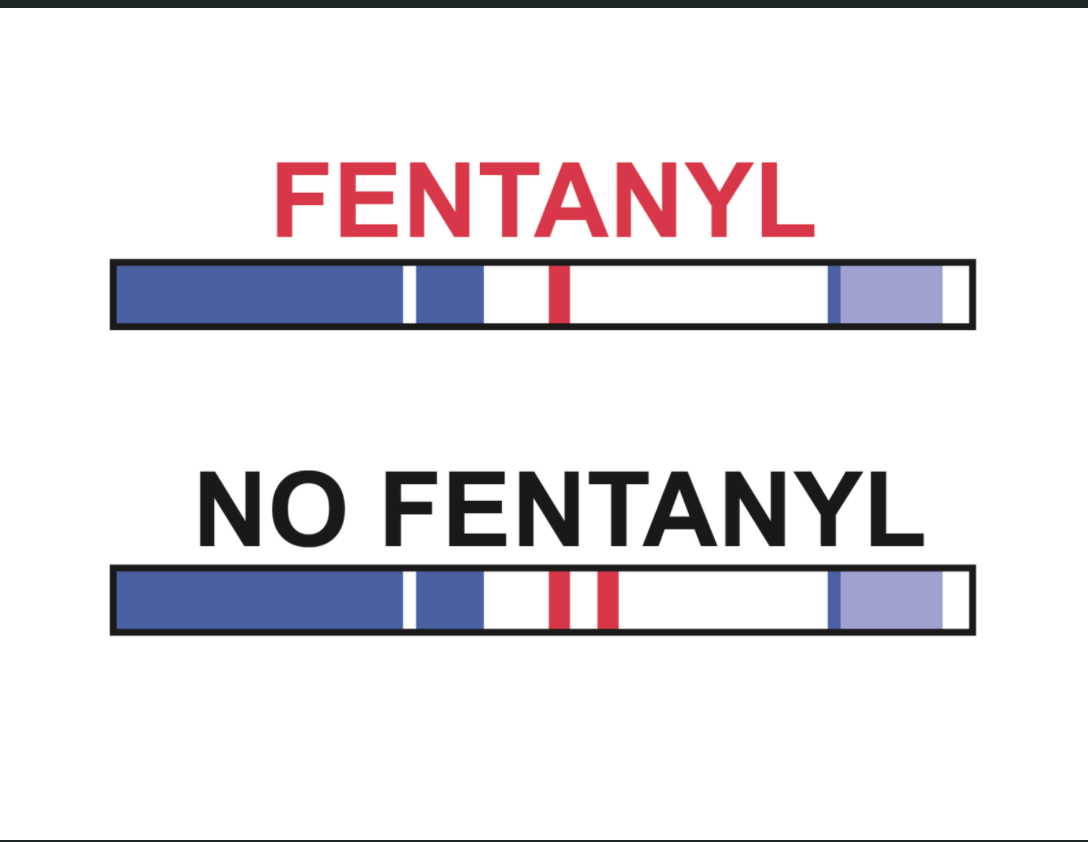
fentanyl

If someone wanted to get fentanyl test strips, how would that happen?

Our preference, mainly when we are talking to young adults, is to pass them out with education. We will be in front of them, teaching them how to use them on each separate type of drug so they use it correctly. That’s our first preference.

My first ask would be if there is a group that needs test strips, invite us out to talk to you. And that is what our focus on fundraising is. We raise money so that we can travel and also purchase strips.

Practically, that is not always possible, so maybe it’s just one person who wants a handful of test strips. We will mail them to individuals, but we ask that they watch a video or talk to us about how to use them.

The third part of that is that we are only four months old. But we’re growing so quickly. One of our goals is to have a very professional video that explains how to use the test strip with each drug. If I were to mail you some strips, particularly in rural areas, I’d also email you the video. That is our goal. We haven’t gotten to the professional video yet, because we are so new. Our preference is to be a very personalized group setting education tool to teach you how to use the strips.

What final words would you have to share with parents?

For parents, particularly, the most important thing I’ve learned is that many parents think of fentanyl as something found in heroin. It’s off in the dark places we don’t think about with our children.

“My sixteen-year-old doesn’t use heroin, so why do I need to worry about this?”

I would stress to parents that it is the old fentanyl story. The new fentanyl story that we are dealing with is that fentanyl can be found in anything your kids take.

If your child doesn’t know that, you need to talk to them about that. You need to teach them. If you are going to take one of your friend’s Adderall to study at night, or if you are going to take a Xanex to relax when you’re feeling anxious once you get to college, that might not be the real Adderall or Xanex.

It could have fentanyl in it.

If you decide one day at a big fraternity party or any party, you want to try cocaine for the first time; cocaine can have fentanyl in it. Parents need to understand that anything their child takes, and I do mean anything, could have fentanyl in it. We try to stress that to parents and hopefully have them stress it again to their kids or college-age students.

Beth Weinstock is a poet and physician from Columbus Ohio, and also a mother of four whose eldest son Eli was murdered in March of 2021 when he unintentionally ingested fentanyl. In honor of Eli, she and her family founded BirdieLight, an organization dedicated to ending the senseless loss of young people due to fentanyl poisoning. She is a physician at Equitas Health and primarily cares for individuals infected with HIV and Hepatitis C. In 2019, she completed an MFA in Poetry at Bennington Writing Seminars, and prior to Covid had taught poetry workshops to medical students, veterans, and incarcerated individuals. Her poems are forthcoming in RHINO Poetry and Cutleaf Journal, and have been published recently in Greensboro Review, The MacGuffin, Global Poemic, Harpur Palate, Headline Poetry, and Press, South Florida Poetry Journal, and High Shelf Press, as well as book reviews in Longleaf Review. She has been nominated for Best New Poets anthology and is a finalist for the 2021 RHINO Poetry/Founders’ Prize and the 2022 Tennessee Williams/New Orleans Literary Festival Poetry Prize. She is currently working on her first book-length manuscript.

Thank you for reading. I know you have many options on content. Don’t forget to sign up for the Sunday newsletter with information and inspiration to help parents.

All In Solutions Counseling Center is a behavioral health network of addiction treatment providers. We inpatient & outpatient substance abuse treatment programs that are individualized to meet each client’s needs. Our specialized programs include:

Our locations include:

How to Tell if Fentanyl is Present: Meet Beth Weinstock of BirdieLight-All In Solutions-All In Solutions - A Solutions Based Behavioral Healthcare Group


from All In Solutions https://ift.tt/ZzHUFcd
from Tumblr https://ift.tt/O4v3wR5
via IFTTT

Friday, March 4, 2022

Letting Go of My Children and Grandchild

Letting Go of My Children and Grandchild

Letting Go of My Children and Grandchild

Mon, 27 Dec 2021 16:10:06 +0000

This article originally appeared on:

al-anon.org/blog/letting-go-of-my-children-and-grandchild/

I have been deeply affected by my children’s drinking and the effect it has had on my grandchild. I have felt an emotional death in my soul which has brought me to a new dependency on a Power greater than myself.

Step One was a long and difficult step for me. Giving up my sense of power and control was a long, slow, painful death. The overwhelming heartache still continues today as I surrender my children and grandchild to the God of my understanding. Daily, I surrender the jumble of feelings of embarrassment, shame, anger, sadness, the gripping fear of loss, needless responsibility for others, secrecy, and denial. I surrender feeling like a failure and my jealousy of others who appear to have achieved the success I felt I deserved. I surrender my need to make myself feel better and more in control by putting others down.

Working the Twelve Steps of Al‑Anon has helped me realize that my happiness, success, safety, and self-esteem do not depend on what another person does or does not do. This old way of thinking kept me from my real source of power, and it led me to Step Two, in which God is restoring me to sanity. I was insane and living in a false belief system. In Al-Anon, I learned that I am not alone in these feelings. Other people also lived in fear, but found, through the program, hope and strength to live a new life. The pain I have felt is being transformed into awareness and acceptance.

I am certainly not perfect at living in peace. I realize it took years for me to develop this false sense of power and security, and I have to work daily at letting it go and accepting that my Higher Power is doing for me what I cannot do for myself. I rely on the strength of my friends in Al‑Anon, who have struggled like I have and yet made choices for themselves that led to new ways of living.

I repeat the slogans, pray the Serenity Prayer, read my literature, call my Sponsor, and value myself enough to know I am worthy of love, respect, and joy in my life. My children and grandchild also deserve this, and with the help of their Higher Power, I trust they will discover their true selves and find contentment. I believe my greatest gift to my children and grandchild is to “Let Go and Let God.”

By P. H.

 The Forum, January 2022

Feel free to reprint this article on your service arm website or newsletter, along with this credit line: Reprinted with permission of The Forum, Al-Anon Family Group Headquarters, Inc., Virginia Beach, VA.

The post Letting Go of My Children and Grandchild appeared first on Al-Anon Family Groups.

All In Solutions Counseling Center is an alcohol and drug treatment network, an alcohol & drug treatment network. We provide outpatient and inpatient addiction treatment programs that are tailored to meet each client’s needs. Our specialized programs include:

Our locations include:

Letting Go of My Children and Grandchild-All In Solutions-All In Solutions - A Solutions Based Behavioral Healthcare Group


from All In Solutions https://ift.tt/NX3RwFZ
from Tumblr https://ift.tt/6bniHQd
via IFTTT

Thursday, March 3, 2022

Al-Anon Saved My Life—Twice!

Al-Anon Saved My Life—Twice!

Al-Anon Saved My Life—Twice!

Tue, 01 Mar 2022 16:59:00 +0000

This article originally appeared on:

al-anon.org/blog/al-anon-saved-my-life-twice/

When I first came to Al‑Anon, I was depressed and sad. I didn’t know how to live with active alcoholism, and honestly, I didn’t know how to go on living anymore. I could have died, but Al‑Anon saved my life.

Later, when I had been in the Al‑Anon program for over a decade, a series of life events overwhelmed me. I was barely able to attend meetings and had limited time to talk with my Sponsor or work the Steps. I began once again to slip into a place of despair. Fortunately for me, most of my friends are in recovery and recognized my declining mental health. They suggested I renew my commitment to meetings and Step work. One friend pleaded with me to attend 30 meetings in 30 days—at least a meeting a day, no matter what. And because I knew I was dying, I made up my mind to do this.

Life didn’t stop and things were crazy, but I went to a meeting every day like my life depended on it. I also started working the Steps from the beginning again, and I prioritized doing Step work each week.

It worked! It really worked. For the second time, Al‑Anon saved my life. I know and have a real experience that proves that the Twelve Steps of the Al‑Anon program, along with a Sponsor and a home group, will work to change my life. I know the way out of the pit of despair. It is through recovery and the Al‑Anon program. This is a gift that I have a responsibility to share with others. Those who do know can be a help to those who don’t even know that they don’t know.

Today, I show up at meetings regularly. I do Step work. I reason things out with fellow members in Al‑Anon, and I make myself available to help others. When I was in a dark place, I wasn’t alone. Now I can make sure that is true for others.

By Shiloh W., Montana

The Forum, March 2022

Feel free to reprint this article on your service arm website or newsletter, along with this credit line: Reprinted with permission of The Forum, Al-Anon Family Group Headquarters, Inc., Virginia Beach, VA.

The post Al-Anon Saved My Life—Twice! appeared first on Al-Anon Family Groups.

All In Solutions Counseling Center is a network of addiction treatment providers. We offer outpatient and inpatient addiction treatment programs that are tailored to meet each client’s needs. Our specialized programs include:

Our locations include:

Did you miss our previous article…
https://www.allinsolutions.com/changing-the-conversation-can-change-everything/

Al-Anon Saved My Life—Twice!-All In Solutions-All In Solutions - A Solutions Based Behavioral Healthcare Group


from All In Solutions https://ift.tt/QbJzBkl
from Tumblr https://ift.tt/BiF29I5
via IFTTT

New Jersey NFL Star Shares His Story Of Addiction Recovery

This article originally appeared on: https://www.jerseyshoreonline.com/ocean-county/nfl-star-shares-his-story-of-addiction-recovery/

LAKEWOOD – Former NFL quarterback Ray Lucas tackled many of his opponents during his time on the field but it was his strength in tackling his opioid addiction that was perhaps the most grueling.

 Lucas recently shared his story of recovery with some Lakewood High School student athletes which served to kick off the Knock Out Opioid Abuse initiative which was sponsored by the Partnership for a Drug-Free (PDFNJ) and Horizon Blue Cross Blue Shield of New Jersey.

 The program is in collaboration with the New Jersey State Interscholastic Athletic Association (NJSIAA) and the virtual event held on February 15, was the first in a series of 10 to be held for high schools throughout New Jersey in the 2021-22 and 2022-23 school years.

 Lucas headlined the event and discussed his story of addiction and recovery with the students. sharing stories from his playing career at Rutgers and in the NFL. He provided details about how he developed an addiction to opioids, and urged students to stay educated and informed about the risks of prescription opioids.

 The athlete explained to them that “opioids effect everyone and does not care about race, religion or backgrounds. Your mouth is your most important weapon. You should ask for help if you need it and make sure to ask the questions about what you’re being prescribed and if there are alternatives.”

 The mission of this virtual conversation was to educate student athletes on the risks of prescription opioids, as well as the importance of taking care of themselves physically and mentally.

 According to a Monitoring the Future survey, adolescent participants in high-injury sports had 50 percent higher odds of nonmedical use of prescription opioids than adolescents who did not participate in these types of sports.

 Lucas, a Harrison native, played for Rutgers University in the 1990s before enjoying a seven-year career in the NFL. He played for three teams, the New England Patriots, New York Jets, and Miami Dolphins from 1996 to 2002. Currently, Lucas works as a studio analyst for the show Jets Nation on SportsNet New York.

 Football took its toll on Lucas, who sustained numerous injuries and underwent more than a dozen surgeries during and after his playing career. The quarterback became dependent on prescription opioids, at times taking more than 1,400 pills a month.

 Lucas has been receptive to sharing his addiction and recovery in an effort to help others who have struggled with the same problems he has and to prevent youth athletes from going down the path to addiction.

 PDFNJ, Executive Director Angelo Valente said, “as New Jersey’s opioid epidemic continues to plague the state, it is vital to reach student athletes and educate them about the dangers of prescription opioids.”

 “We all need to be part of the solution, and are grateful to Ray Lucas for sharing his story with the Lakewood students and to Horizon Blue Cross Blue Shield of New Jersey and the New Jersey State Interscholastic Athletic Association for making these events possible,” Valente added.

 In Ocean County, from January through November 2021, there have been 809 naloxone administrations to reverse opioid overdoses and 228 suspected overdose deaths.

 Two years ago, more than 3,000 people in the state died of drug overdoses, most of which involved some form of opioid. Preliminary data shows that New Jersey was on pace to end 2021 with more than 3,200 overdose deaths, which would be the most since the state started keeping records a decade ago.


Individuals struggling with addiction in New Jersey can get help at All In Solutions Counseling Center Cherry Hill. 

Cherry Hill Addiction Treatment Center

1930 Marlton Pike East building t, Cherry Hill, NJ 08003
18563365806


from Tumblr https://ift.tt/NHVai4d
via IFTTT

Understanding the Cycle of Addiction

Understanding the Cycle of Addiction Millions of people and their families are impacted by addiction. Although it’s such a widespread issue...