Tuesday, March 29, 2022

New Jersey Recognizes Changing Opioid Overdose Demographics

New Jersey Recognizes Changing Opioid Overdose Demographics

In 2021, more than 3,000 people in New Jersey lost their lives to drug overdoses. The majority of these overdoses were caused by opioids and many were linked to illicit fentanyl. New Jersey, like many other states in the US, have made efforts to curb the effect of the opioid epidemic by improving access to opioid addiction treatment and increasing funding for addiction awareness, education, and harm reduction. An alarming new trend has begun to appear, however. The opioid epidemic’s traditional face, which had long been disproportionately white, has changed as Blacks are now more likely to die of overdose.

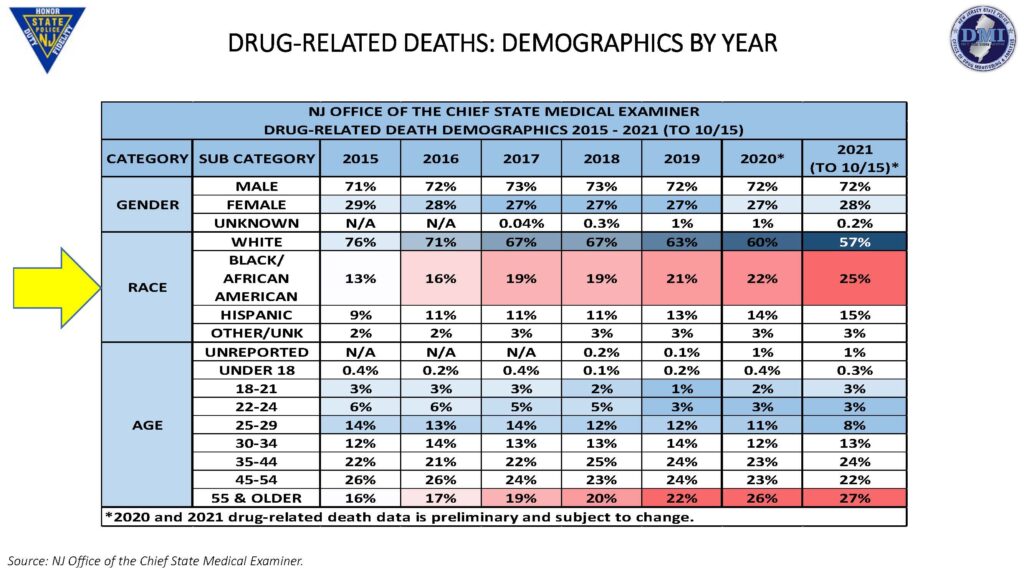
New Jersey Drug Overdose Deaths by Race

NJ Governor Phil Murphy stated at a recent opioid addiction event (which announced the Johnson & Johnson settlement the state is set to receive), “We know racial disparities exist everywhere, and this is no exception.” As of 2021, after several years of trend reversal, Blacks are now more likely to suffer fatal drug overdose than whites.

In 2021, the Black/African American community made up 12.4% of the population of New Jersey, but accounted for more than 25% of the overdose death rates. Whites in 2021 made up 51.9% of the population and 57% of overdose deaths in New Jersey. Some historical numbers help to put this shift into perspective.

Just a few years ago, in 2015 whites accounted for 76% of overdose deaths. In that time, the the demographics of the population haven’t changed that significantly, but the impact of opioids on the Black community absolutely have. Hispanics now also make up a larger portion of overdose deaths, representing 15% of deaths (a rise from 9% in 2015).

Source: https://www.nj.gov/oag/njcares/databyrace/Drug-Related%20Death%20Data.pdf

Why the Spike in Black Overdoses?

There is no one cause for the transformation, according to many addiction professionals and community advocates. They blame the shifts on long-standing disparities in healthcare access, as well as the lethal emergence of fentanyl, a strong synthetic increasingly found in heroin and other illicit narcotics like cocaine and counterfeit pharmaceuticals.

Furthermore, the COVID-19 pandemic has had a vast but unequal impact. They claim that the coronavirus not only disproportionately affected people of color, but it also contributed to an overall rise in drug usage, fueled by isolation, economic uncertainty, and emerging social worries.

Harrison Dillard, a former narcotics detective in Morris County and current president of the Hunterdon County NAACP said, “When things are good, they are not as good for people of color. And when things are worse, they are that much worse for people of color. This kind of shines a light on ongoing disparities.”

New Jersey has been working for years to improve its fractured treatment system, increasing availability of naloxone, an overdose reversal medicine, and pushing opioid maintenance meds like buprenorphine, which lower cravings. New Jersey increased its efforts and removed restrictions to telemedicine in the wake of the coronavirus epidemic. This made it easier for those suffering from addictions to communicate with their counselors and physicians over the internet.

But according to Dr. Kaitlan Baston of Cooper Center for Healing and Dr. Alexis Lapietra of St. Joseph’s University Medical Center, the efforts made to confront the problem of addiction have overlooked the Black community. They claim that black people continue to encounter higher challenges in getting treatment and obtaining proven-to-work drugs like buprenorphine.

For example, they added, urban Blacks are frequently assigned to methadone programs, which require users to visit a clinic every day to acquire their prescriptions. Commuters and parents without anybody to watch their children may face difficulties as a result.

In contrast, doctors can prescribe buprenorphine during an office visit, allowing patients to get up to a month’s supply to use at home.

Other inequalities exist and may contribute as well, such as poverty, a lack of insurance, transportation, or secure housing.

New Jersey Opiate Addiction Treatment

All In Solutions Counseling Center Cherry Hill offers treatment programs to help with all forms of substance use disorder, including opioid addiction. With individualized inpatient and outpatient programs and optional medication-assisted treatment plans, our New Jersey rehab is equipped to help individuals of every age, background, and walk of life find recovery and mental health. Call or visit our Cherry Hill addiction treatment center today to learn more.

New Jersey Recognizes Changing Opioid Overdose Demographics-All In Solutions-All In Solutions - A Solutions Based Behavioral Healthcare Group


from All In Solutions https://ift.tt/3bPwJaj
via IFTTT

Monday, March 28, 2022

How Will NJ Johnson & Johnson Opioid Settlement Impact Addiction in Camden County?

How Will NJ Johnson & Johnson Opioid Settlement Impact Addiction in Camden County?

New Jersey to Receive Settlement from Opiate Manufactureres & Distributors

Officials in New Jersey announced on March 11, 2022 that the state will receive $641 million in settlements from opioid manufacturers and distributors, which will be shared between the state and local governments.

Johnson & Johnson, located in New Brunswick, manufactured the opioids, and will pay part of the settlement. The remainder will come from McKesson, Cardinal Health, and Conshohocken-based AmerisourceBergen, the country’s three largest pharmaceutical wholesalers.

Prior to a roundtable discussion on how the money will aid in the battle against the opioid epidemic, Gov. Phil Murphy and Acting Attorney General Matt Platkin made the news public from Behavioral Crossroads Recovery in Egg Harbor Township.

The state of New Jersey is getting the most money possible. The businesses will make payments until 2038. The state will get 50% of the settlement, with the other half distributed among the 21 counties and 241 municipalities.

How Camden County Will Benefit

Of the $641 million dollars, Camden County will receive $32 million in distributions over the next 20 years. Lou Cappelli, the Camden County Commissioner Director called the additional funding a game changer, saying, “By having the funds from this settlement and future settlements, we will have a nice pipeline of funds that will be able to help our residents moving forward.”

Per the terms of this settlement, the money will go toward funding addiction treatment programs, including medication-assisted treatment for OUD, addiction awareness education efforts, and harm reduction initiatives. The funding is badly needed in Camden County, where unmet demand for substance abuse treatment as a percent of total demand is over 54%.

While 2021 saw a decrease in fatal overdoses in Camden County compared to the previous year, the state of New Jersey as a whole saw a 1% increase. Of the 290 overdose deaths that occurred in Camden County in 2021, 93% had opioids present in toxicology reports and 70% had fentanyl present.

All In Solutions Cherry Hill – Camden County Opiate Addiction Treatment

Individuals struggling with opioid addiction in Camden County can receive effective inpatient and outpatient treatment at All In Solutions Cherry Hill. The New Jersey opioid addiction treatment program offers both traditional and medication-assisted treatment plans to help individuals overcome addiction to prescription opiates and illicit drugs like heroin. Call today or visit our Cherry Hill treatment center to learn more about our substance use disorder treatment programs.

How Will NJ Johnson & Johnson Opioid Settlement Impact Addiction in Camden County?-All In Solutions-All In Solutions - A Solutions Based Behavioral Healthcare Group


from All In Solutions https://ift.tt/afG7E1U
via IFTTT

Friday, March 25, 2022

5 Things to Consider if Your Child has a Relapse

5 Things to Consider if Your Child has a Relapse

5 Things to Consider if Your Child has a Relapse

Fri, 28 Jan 2022 15:43:23 +0000

This article originally appeared on:

cathytaughinbaugh.com/child-has-a-relapse/

Are you feeling anxious your child might relapse now that he is sober?

Would you like to have some strategies that could help?

As a parent, it is easy to feel that all the support you’ve given has been in vain if your child has a relapse.

Yet there are things you can do to support your teen or young adult and help them get back on their recovery path.

There is no one-size-fits-all when it comes to relapse. Relapse is common and often a part of the recovery process.

Your child can learn new coping strategies to strengthen their resiliency in recovery.

Generally, a relapse happens due to a trigger.

The following are common triggers for relapse:

Overwhelming stressProlonged symptoms of withdrawal, even after detoxBeing around friends associated with your addictive behaviorsYour child’s environment with close access to the substance of choiceNegative emotions, like grief or angerHoliday parties, birthdays, weddings, and other celebrationsSymptoms from underlying mental health issuesPhysical health issues, especially those leading to chronic painIt might be because your child is around friends who are using, a familiar environment, stress, withdrawal symptoms, or a lack of support.

Any change is a process filled with ups and downs. It helps to prepare yourself in case a relapse happens. Habits take time to develop. Your child may slip up at some point before they build the skills needed to sustain long-term recovery.

Here are some ideas that can help you support your child:

1. Plan ahead for the possibility of a relapse.

Your child will do relapse prevention planning in their treatment program. It helps if parents do it too.

It may feel awkward or that you are willing a relapse to happen if you bring it up. But it is better to discuss a slip or relapse before it happens so that you both have a sense of your next steps in case it happens.

How would you like to respond in case a relapse happens so that you can help your child return to healthy behaviors? When we react in the moment, we tend to get emotional or start yelling. That will only cause your child to feel more shame about the situation. What can help is to think through how you would want to react so that you can both learn from the experience and move forward in a positive way.

Planning for relapse is like taking out insurance. You hope it never happens, but if it does, you have a backup plan. Planning will help you worry less and feel more in control.

Create an environment where you can have a healthy conversation with your child. Explore what went wrong. What can we do better?

Have a Plan B in case relapse should occur. You can remain flexible, yet having a plan in mind may help you feel less worried.

He could detox and reenter a treatment program if the relapse is severe. If it is more of a slip and your child is ready to get back to recovery, he could gather support around him. A counselor, recovery coach, or support group can help.

While it is frustrating and painful, relapse can often be a bump in the road. With a few small steps, your child can get back on their recovery path.


Relapse

2. Maintain a positive relationship 

Create an environment where your child feels safe talking with you. A positive relationship can help if they are experiencing challenging moments in their recovery.

We know that “Insanity is doing the same thing over and over again and expecting different results.”

How can we stay away from insanity? How can I support you and help you live a healthy life?

Listening helps. Allow your child to have a conversation with you where they don’t feel judged, shamed, or disrespected.

Any kind of change is hard. While it is a disappointment, your child has done the hard work before and can return to more healthy behaviors.

Praise them for what they’ve done in the past. Ask how you can support your child in the future.

It’s like riding a bike. Your child knows what he needs to do. It’s a matter of climbing back on and pressing the pedals forward once again.

When they relapse, okay, let’snot condemn them. Let’s not put them to deathbecause they had one or two days where they went backward. Let’s start all over again and keep that positive attitude. ~ Robert Meyers, PhD

3. Manage Your Anxiety

Obsessive thinking involves a lot of “what if’s”. What if he relapses, loses his job again, or has to go back to treatment? What if she never wants to quit? This type of thinking is fear of the future.

Ask permission to talk to your child ahead of time so that you both are clear.

Have a conversation about your worries. Ask, “If I notice that your child’s behavior is a sign of being high in the past, can I bring it up to you? Is that okay?

Stay as positive, calm, and hopeful as possible. It will help you both continue on the journey to healthier living.

From SMART Recovery. Here are some tips for tackling your anxiety when negative thoughts linger.

Call someone you trust. Let them know that your anxiety has gotten the best of you and that you need their support. That may mean asking them to stay on the line with you until you’ve worked through your symptoms or coming over to keep you company and help you put your mind at ease.Do something physical. Take a brisk walk, go up and down the stairs, or do some jumping jacks. Give your body a way to use up some of the excess energy.Distract yourself – try an adult coloring book, knit, crochet, or draw. Repetitive activities, like meditation, can have a calming effect.Go somewhere, safe and quiet. Challenge yourself to have a full-blown anxiety attack. Many people find that challenging themselves to have an anxiety attack has the opposite effect.Deep breathing can help. One popular method is belly breathing. Lie on your back and breathe in through your nose, watching your belly rise as you inhale. Hold your breath for a few seconds, then exhale deeply through your mouth. Watch your belly fall as you exhale. Repeat until you notice yourself feeling more relaxed. Singing can also regulate your breathing if you find yourself starting to hyperventilate.Write it down. Getting thoughts out of your head and onto paper can be helpful. It could be making a to-do list to organize your thoughts if your mind is racing and it’s hard to focus. Or write in a journal to express what is bothering you.Focus on things you can control and take action. Pick out your clothes for the week. Plan your meals for the next couple of days, and organize your desk. Taking care of small things empowers you to take charge of larger tasks.

Catch yourself when you drift into “what if” thinking territory. Pull yourself back to the present. In the present moment, what is happening? Remember, the situation can change on a dime. There are many paths to recovery – perhaps, not in the straight line you would wish for, but it happens all the time. ~ Pat Aussum

4. Consider Possible Triggers to Relapse

Unfortunately, relapse is sometimes part of addiction recovery. 

This process of considering what triggers could get in the way of your child’s recovery is helpful so that you can be supportive. You may want to share this with your child too.

Here are six questions to consider in case a relapse should happen from Dr. Carrie Wilken’s article, “Finding Your Way Through a Relapse.” 

Questions to Ask Yourself:

What were the internal (e.g., thoughts and feelings) triggers that contributed to a return to old behaviors? For example, were you feeling lonely because you avoided friends who continued to use? Were you struggling with critical thoughts about your ability to make a change at all?What external triggers (e.g., stress at work, fighting with a friend, or financial worries) contributed to a return to old behavior patterns?Once you have identified the triggers, try to identify ones that could be changed or avoided.Think about the plan for change you had before the relapse; was it specific enough? And if you had a plan, did you carry it out or just think about it.Was there something unexpectedly hard that happened? Something you did not see coming or anticipate as a problem.While you were trying to make changes, what were the biggest problems you faced?

5. Stay optimistic

Rather than looking back, do appreciate what your child has accomplished. Support your child as they continue to take baby steps forward.

It takes courage to live in recovery. Every day, your child must choose to lead a new life without the crutch of drug or alcohol use.

Celebrate the steps that your child has taken to change their life. Please encourage them to continue on their recovery path. You will have a more optimistic outlook when you are grateful for how far they’ve come.

Finally, take care of yourself. That’s the best way to help your son or daughter. Eat well, get enough sleep, be sure to exercise, and keep doing the things you like, such as hobbies, sports, or crafts — whatever it is that you enjoy. You will be a role model for your child, and self-care will help you stay resilient.

Even though a relapse is not the outcome you were hoping for, it’s crucial to have a positive outlook, both for your sake and your childs’.

Thank you for reading. I know you have many options on content. Don’t forget to sign up for the Sunday newsletter with information and inspiration to help parents. Sign up now.

All In Solutions Counseling Center is a network of addiction treatment providers. We provide outpatient & inpatient substance abuse treatment programs that are customized to meet each client's needs. Our specialized programs include:

Our locations include:

Did you miss our previous article…
https://www.allinsolutions.com/alcohol-by-volume-abv-and-proof-explained/

5 Things to Consider if Your Child has a Relapse-All In Solutions-All In Solutions - A Solutions Based Behavioral Healthcare Group


from All In Solutions https://ift.tt/6GOzgS2
via IFTTT
Thursday, March 24, 2022

Alcohol By Volume (ABV) and “Proof” Explained

Alcohol By Volume (ABV) and “Proof” Explained

Alcohol By Volume (ABV) and “Proof” Explained-All In Solutions-All In Solutions - A Solutions Based Behavioral Healthcare Group


from All In Solutions https://ift.tt/fyXYjsN
via IFTTT

Florida: Most Fentanyl Deaths in US

Florida: Most Fentanyl Deaths in US

According to a study conducted by Families Against Fentanyl using data from the Centers for Disease Control and Prevention, illicit fentanyl fatalities reached 64,000 last year (CDC). And of all the states that have a problem to address, perhaps the most alarming is Florida’s fentanyl deaths.

Florida, more than any other state in the US, lost 5,161 individuals to illegal fentanyl last year. Florida was not just the state with the most overall fentanyl deaths last year, but it was also in the top 20 states in terms of fentanyl deaths per capita. On February 28, a report titled “Fentanyl: The State We’re In” was issued. Last year’s data refers to the most recent 12-month period for which CDC data was available at the time of research, which ended in May 2021.

Families Against Fentanyl also discovered that illegal fentanyl fatalities in Florida had more than doubled since 2019, with a 2.3x rise.

The overdose spike of over 200% in the last 2 years puts Florida in a class with only 30 other states. Teenage deaths are increasing at an alarming rate. In the same time span, fentanyl-related mortality among teenagers in the United States more than quadrupled. The number of black teenagers who have been poisoned with fentanyl has surged fivefold.

The spike since 2015 is even more staggering. Since then, fatalities attributed to fentanyl have increased by 547% in the US and by 746% in Florida. Since then over 16,000 lives have been lost to fentanyl.

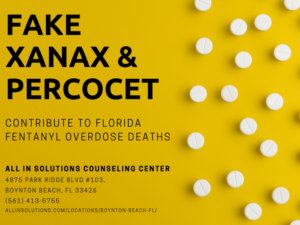
James Rauh, founder of Families Against Fentanyl, attributes some of the increase in fatalities to the rise in fentanyl being used to create fake pills. “The fentanyl crisis is getting worse, not better. Fake pills with deadly amounts of fentanyl are popping up everywhere. It’s in fake Xanax and Percocets, it’s being laced in cocaine and ecstasy. A single pill can kill,” Rauh said.

Dr. Roneet Lev, who used to serve in the White House Office of National Drug Control Policy has urged policy makers to take action against the fentanyl crisis, “with the same vigor and approaches as we do the coronavirus.” As an emergency physician he has seen many fentanyl overdose fatalities, in both drug users and unsuspecting children and other who accidentally came in contact with the substance.

fake pressed xanax and percocet pills containing fentanyl leading to overdose in Florida

All In Solutions Boynton Beach Rehab Responds to Florida Fentanyl Deaths

“Anybody who works in addiction treatment will agree that this rise in fentanyl overdoses we’ve seen in the community is unprecedented,” said the Boynton Beach rehab Clinical Director Albert Zingariello, LCSW. He continued to say that Florida, specifically, has been hit hard. “We are fortunate to have a very active and engaged alumni community, so we inevitably find out when one of our past clients tragically overdoses. As a treatment provider, we are taking steps to better ensure the safety of our current and past clients. Our staff are all well trained in using Narcan and responding to overdose. Our alumni team works tirelessly to keep past clients engaged in their recovery. And while patients are in our care, we’re making a more focused effort to educate about the dangers surrounding fentanyl – specifically when it comes to fake pills,” Zingariello added.

All In Solutions Counseling Center offers opiate addiction treatment programs with optional medication-assisted treatment plans. If you or someone you know are struggling with opioids, including fentanyl, don’t hesitate to reach out for help by calling us at (855) 762-3796.

Florida: Most Fentanyl Deaths in US-All In Solutions-All In Solutions - A Solutions Based Behavioral Healthcare Group


from All In Solutions https://ift.tt/EDvtHSy
via IFTTT

Wednesday, March 23, 2022

The Color of Hope

The Color of Hope

The Color of Hope

Wed, 26 Jan 2022 16:13:25 +0000

This article originally appeared on:

al-anon.org/blog/the-color-of-hope/

Looking out the window one frigid February day, the scene before me was dull and colorless. Snow was flying, the ground covered in white, and gray, naked trees blew forlornly in the wind. I had just ended a phone call with my alcoholic son because one of my comments sent him into a rage. I felt bewildered, but I used my Al‑Anon tools to decide it was best not to engage. I know I don’t have to participate in hurtful behavior. I received dozens of text messages and phone calls from him after we hung up, and I finally made the choice to silence my phone.

When I looked out the window again, I was reminded by my Higher Power that prayer, Al‑Anon meetings, and literature could help me see that under the snow and dirt are flower bulbs that will soon break through with vibrant colors. “This too shall pass.” I can trust that green grass, leaves, and colorful blossoms will come.

Earlier that morning, I had attended an electronic Al‑Anon meeting. One of the readings was from page 85 of Courage to Change (B-16), which gave me a healthier perspective on my phone call with my son. It clarified who I am responsible to and what I am responsible for (myself) and who and what I am not (my alcoholic son). That one page was full of truths and fruitful wisdom that refreshed me in the midst of my loved one’s insanity. I am grateful to Al‑Anon for giving me the perspective to see a brighter color scheme for my life. Today, I will bloom where I am planted, knowing there’s help and hope in Al‑Anon.

By Joan K., Illinois

The Forum, February 2022

Feel free to reprint this article on your service arm website or newsletter, along with this credit line: Reprinted with permission of The Forum, Al-Anon Family Group Headquarters, Inc., Virginia Beach, VA.

The post The Color of Hope appeared first on Al-Anon Family Groups.

All In Solutions Counseling Center is a drug and alcohol treatment network. We offer inpatient and outpatient substance abuse treatment programs that are customized to meet each client's needs. Our specialized programs include:

Our locations include:

The Color of Hope-All In Solutions-All In Solutions - A Solutions Based Behavioral Healthcare Group


from All In Solutions https://ift.tt/CgO4rs8
via IFTTT

Tuesday, March 22, 2022

8 Helpful Ways to Feel Happier When Times Are Difficult

8 Helpful Ways to Feel Happier When Times Are Difficult

8 Helpful Ways to Feel Happier When Times Are Difficult

Sun, 20 Mar 2022 21:38:01 +0000

This article originally appeared on:

cathytaughinbaugh.com/8-helpful-ways-to-feel-happier-when-times-are-difficult-2/

Are you looking for ways to feel happier?

Would you like some tips on how to help yourself?

I’m a big fan of watching people grow and become healthier, happier versions of themselves. ~ Unknown

Sometimes life throws us a curveball. Things happen that you weren’t expecting. You can feel uncertain about what to do next.

The stress can be overwhelming when your child struggles with drugs or alcohol. The world around you seems out of control. It is good to remind yourself that everything is temporary, whether it’s good times or bad.

While your life may be upside down at this time of uncertainty, you will get through this. You will get back on track.

8 ways to feel happier pin

In the meantime, here are some things I’ve been doing that I’ve found helpful. I hope you can find ways to feel happier in this unprecedented situation.

1. You’re doing the best you can.

When trouble strikes, you may focus most of your energy on the issue, which is understandable. Things have a way of feeling out of balance. So while you may feel added anxiety, recognize that you are doing the best you can. That is all that you can expect from yourself. Focus on what you can do. Have compassion for yourself and others.

You’ve been criticizing yourself for years and it hasn’t worked. Try approving of yourself and see what happens. ~ Louise Hay

2. Write down your feelings.

I am not always consistent with journaling. I write so much that I don’t always get to my journal. Yet, I’m finding that journaling is a great thing to do right now. It will make you feel better as you get your thoughts on paper.

You will have a record of what went on for you. It might be interesting in the future to look back at your feelings when we were all concerned about COVID-19. Research shows that your stress level will decrease even if you journal only a few times a week.

Journal writing is a voyage to the interior. ~ Christina Baldwin

3. Take a moment and breathe to feel happier.

Find time tolisten to your breath. Give your mind a rest from what is going on around you. Want more? Sit for 15-20 minutes. You will begin to remember how it feels to be calm. Meditation is a fantastic tool to connect with your inner self. It is a way to find some quiet moments each day to renew and allow your mind to rest.

If meditation is not your goal, giving yourself a few peaceful moments throughout the day will be calming. You could do a walking meditation where you are moving your body and listening to your breath. It will help calm you down and make you feel a bit more relaxed.

You can’t calm the storm, so stop trying. What you can do is calm yourself. The storm will pass. ~ Timber Hawkeye

4. Spend time with friends and family.

It has made it challenging to visit with family and friends during the last two years. Hopefully, we are beginning to see the light at the end of the tunnel. So the more you can plan time to connect with family and friends, the better. If you can connect safely, that usually feels better.

Find things that can help you feel connected. Take time each week to be sure you have at least one thing planned, whether an in-person visit or a phone call so that you don’t feel isolated.

Cherish your human connections: your relationships with your friends and family. ~ Joseph Brodsky


5. Take care of your health.

Eat healthy food. Try to get as much sleep as possible. Drink lots of water. The more you can take care of your health, the better you will feel. The healthier you are, the better your chances of staying well during this time. Do things to keep physically fit and mentally strong. Self-care has never been more critical than now. It will help you stay as positive as possible. The more you take care of yourself, the better off your child will be.

Your body is your most priceless precious possession…so take care of it.  ~ Jack La Lalanne

6. Getting outside and taking a long walk will help you feel happier.

Walking is still one of those activities that most of us can do. You feel better when you move your body. Physical exercise can help improve your mood. It can also relieve some of your stress during this trying time.

You will find that any daily tension will lessen with movement and physical activity. You’ll have more energy and feel more optimistic. Walking or doing any exercise can help you remain calm in everything you do. I love my long daily walk. We have a beautiful trail, but there are more people there, so I try and walk on the streets. As we all know, the more we can avoid close contact, the better. 

An early morning walk is a blessing for the whole day. ~ Henry David Thoreau

7. Do a few projects around the house. 

Now is the perfect time to get a few things done around the house that you may have been putting off. The closets and drawers are an excellent place to start for a reorganization and cleaning. It can feel so free to have more space and eliminate things you aren’t using from your life. If there are home projects you can do now, when we are all in a better place, you’ll feel that you’ve accomplished something.

From the moment you start tidying, you will be compelled to reset your life. ~ Marie Kondo

8. Remember that this, too, will pass.

Nothing is permanent. Sooner or later, your life will get back to normal. Whether it be the pandemic or your child’s substance use, looking back, I hope you will walk away with something new that you’ve learned.

There are silver linings to any crisis. You have a chance to put your life on pause and reevaluate what is important to you.

Your child’s substance use was nothing that you planned on. Life will move forward. You will feel happier again. Use this time to the best of your abilities. You can face whatever comes your way with a sense of strength.

When life gets hectic and you feel overwhelmed, take a moment to focus on the people and things you are most grateful for. When you have an attitude of gratitude, frustrating troubles will fall by the wayside. ~ Dana Arcuri

My best wishes to you and your family. May you and your loved ones stay healthy and have happier times ahead.

This article was updated on March 20, 2022.

Learn research-based tools that can help you motivate your child to change. Add the Sunday newsletter to your weekly routine. Sign up now.


All In Solutions Counseling Center is a drug and alcohol abuse treatment network. We offer inpatient and outpatient substance abuse treatment programs that are tailored to meet each client's needs. Our specialized programs include:

Our locations include:

Did you miss our previous article…
https://www.allinsolutions.com/how-to-help-your-child-prevent-relapse/

8 Helpful Ways to Feel Happier When Times Are Difficult-All In Solutions-All In Solutions - A Solutions Based Behavioral Healthcare Group


from All In Solutions https://ift.tt/K37RMtk
via IFTTT

Understanding the Cycle of Addiction

Understanding the Cycle of Addiction Millions of people and their families are impacted by addiction. Although it’s such a widespread issue...